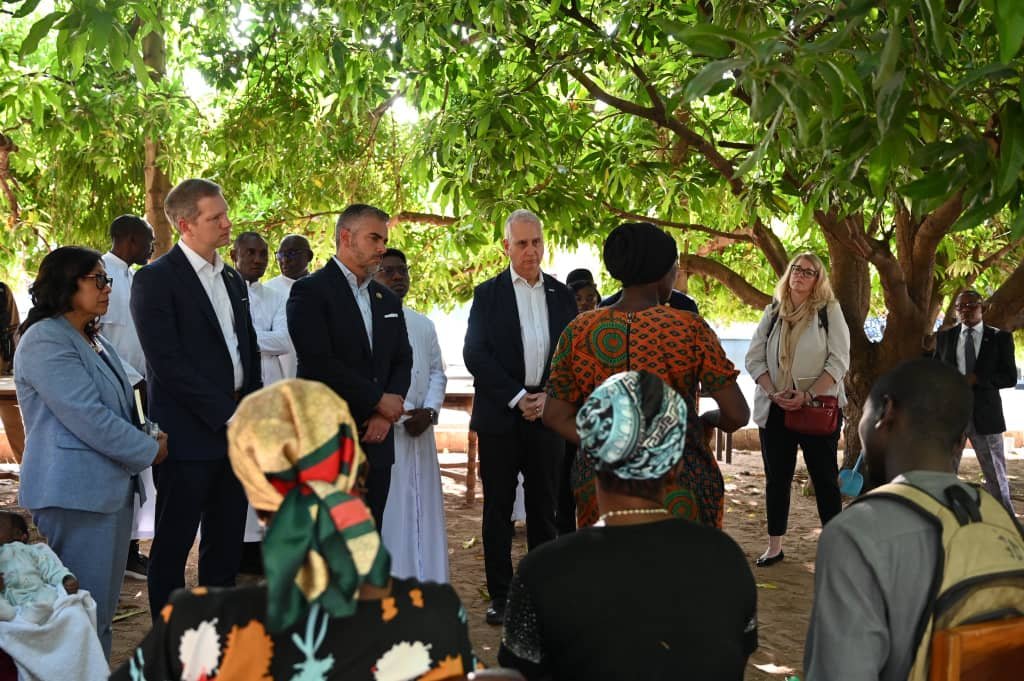

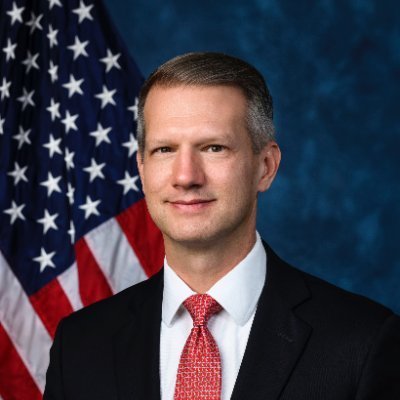

American Congressman Riley Moore (R-WV) stood inside a crowded internally displaced persons (IDP) camp in central Nigeria this week as gunfire echoed in the distance and survivors recounted night-time raids by armed Fulani militants.
“What I have seen with my own eyes is nothing less than an anti-Christian genocide,” Moore told reporters after visiting several camps in Benue State, one of the epicenters of Nigeria’s long-running farmer-herder conflict that has increasingly taken on religious overtones.
Moore, a member of the House Foreign Affairs Committee and Treasurer-elect of West Virginia, described militants storming camps meant to shelter Christians who had already fled earlier waves of violence.
“These are not random clashes,” he said. “These are deliberate attacks on people because of their faith.
Churches are being burned, pastors executed, and entire communities wiped out.”
The congressman’s fact-finding trip comes just weeks after the United States, on November 18, 2025, redesignated Nigeria as a “Country of Particular Concern” (CPC) for severe violations of religious freedom — a move widely seen as fulfilling a threat made by President-elect Donald Trump during the 2024 campaign.
Nigeria now accounts for more Christian deaths from persecution than the rest of the world combined, according to the 2025 World Watch List published by Open Doors International.
The organization documented 4,598 Nigerian Christians killed for faith-related reasons in the past year alone, alongside the destruction of more than 19,000 churches and Christian buildings since 2009.
In Benue and neighboring Plateau, Kaduna, and Adamawa states, the violence follows a familiar pattern: heavily armed groups, often identified by survivors as Fulani herdsmen, attack farming communities at night.
Homes are torched, residents killed or abducted, and survivors flee to makeshift camps run by local churches or the state government.
Many of those camps have themselves come under direct attack in recent months.
One survivor in Abagana camp, 62-year-old Mama Veronica, showed Moore the bullet scars on her leg from an August raid.
“They came shouting ‘Allahu Akbar,’ shooting everyone,” she said.
“I hid under the bodies of my neighbors. When I came out in the morning, my church was ashes.”
Moore said he would brief President Trump and incoming Secretary of State Marco Rubio immediately upon his return to Washington.
“America cannot sit silently while thousands of innocent Christians are slaughtered and displaced,” he declared.
“Sanctions, aid conditionality, and direct diplomatic pressure must be on the table.”
The Nigerian federal government has consistently rejected the genocide label, describing the violence as mutual “farmer-herder clashes” driven by climate change, land disputes, and economic competition rather than religion.
Presidential spokesman Bayo Onanuga called Moore’s statements “unfortunate and inflammatory,” insisting that both Christians and Muslims have died in the conflict.
However, human-rights monitors and many local leaders dispute the symmetry.
The International Committee on Nigeria (ICON), a coalition of Nigerian diaspora and international advocacy groups, estimates that more than 62,000 Christians have been killed and 6 million displaced in the Middle Belt region since 2015.
Governor Hyacinth Alia of Benue State, a Catholic priest before entering politics, welcomed Moore’s visit. “For too long the world looked away,” he said.
“We are grateful that an American lawmaker has come, seen, and is willing to speak the truth.”
As Moore prepared to depart Nigeria on Thursday, fresh attacks were reported in southern Kaduna, where at least 37 people were killed in coordinated raids on December 9–10.
Local sources say the victims were predominantly Christian farmers.
Whether the incoming Trump administration will follow through on threats of sanctions or travel bans remains uncertain, but Moore’s highly public trip has thrust Nigeria’s worsening religious freedom crisis back into the international spotlight at a moment when the United States appears ready to adopt a more confrontational stance.
For the tens of thousands of displaced families huddled in Benue’s camps, the congressman’s promise of action offers a flicker of hope amid years of despair.
“We just want to go home and worship in peace,” said 28-year-old James Agbo, cradling his infant daughter inside a tent made of tarpaulin and sticks. “If America speaks, maybe someone will finally listen.”