

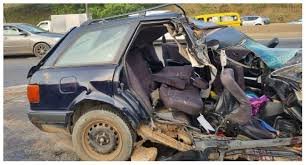

A horrific accident on the Lagos-Ibadan Expressway claimed the lives of three people and left several others seriously injured on the morning of 10 December 2025.
The collision occurred near the State Secretariat, just before Otedola Bridge, on a stretch of road that has become tragically familiar to Nigerians for all the wrong reasons.
According to eyewitnesses and official reports, an Audi sedan travelling towards Berger at high speed slammed into the rear of a slow-moving truck.
The force of the impact crushed the car almost beyond recognition and pulled a third vehicle into the wreckage.
The three occupants of the Audi died instantly. In a disturbing turn, the truck driver fled the scene immediately after the crash and remains at large.
Emergency teams from the Lagos State Traffic Management Authority (LASTMA) and the Lagos State Ambulance Service (LASAMBUS) responded swiftly.
Paramedics fought to save the injured while officers worked for hours to clear the mangled vehicles and restore traffic flow.
Images and video shared online showed a scene of utter devastation: shattered glass, twisted metal, and grieving bystanders trying to help.
For many Nigerians, this tragedy feels painfully familiar. The Lagos-Ibadan Expressway is the country’s busiest corridor, yet it consistently ranks among the deadliest.
Poorly maintained sections, inadequate lighting, reckless driving, and overloaded trucks contribute to a steady stream of fatal accidents.
Federal Road Safety Corps figures show that more than two hundred people lose their lives on this single highway every year, with thousands more left with life-changing injuries.
Across social media, sorrow quickly turned to anger. People shared prayers for the deceased and condolences for their families, but many also demanded answers.
“How many more lives must be lost before something is done?” one user wrote.
Others pointed to long-standing problems: the lack of functional pedestrian bridges, the absence of speed cameras, and the slow pace of road rehabilitation projects.Behind every statistic are real families now facing unbearable grief.
Parents have lost children, children have lost parents, and survivors are beginning long and uncertain journeys toward recovery.
Local humanitarian groups and faith-based organisations have already begun reaching out, offering counselling, financial assistance, and a shoulder to lean on during this dark time.
Road safety advocates are once again calling on federal and state authorities to treat the expressway as the emergency it has become.
They argue that practical measures—stronger enforcement against speeding and drunk driving, regular vehicle inspections, better lighting, and the completion of stalled reconstruction work—could prevent countless future tragedies.
As traffic begins to flow again past the spot where three lives ended so suddenly, the message from ordinary Nigerians is clear and heartbreakingly simple: these deaths were not inevitable.
With political will and genuine commitment, the Lagos-Ibadan Expressway does not have to remain a place of mourning.
The families shattered by today’s crash deserve action, not just words, so that no one else has to endure the same pain tomorrow.