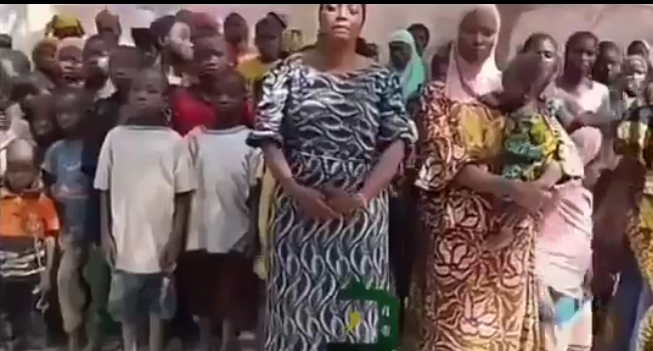


Terrorists paraded 176 abducted women and children in a video released on February 14, 2026, accusing the Kwara State government of downplaying the scale of their abductions following a brutal attack that claimed over 160 lives in Woro and Nuku villages.
In the disturbing footage circulating on social media, the terrorists interrogate the captives, who confirm their origins from the ravaged communities in Kaiama Local Government Area.
The victims, mostly women and young children dressed in tattered clothes, appear distressed as the terrorists boast about capturing far more people than the government’s reported 20 to 30 abductions.
This brazen display has sparked widespread outrage across Nigeria, with citizens condemning the security lapses that allowed such a tragedy to unfold.
The horror traces back to February 3, when hundreds of terrorists stormed the Muslim-majority villages around 5 p.m., unleashing a night of terror that lasted until the early hours of the next day.
They shot residents at close range, bound and executed others, and set fire to homes, shops, and vehicles, leaving behind a trail of charred ruins.
Survivors recount how the attackers targeted civilians who refused to adopt their extremist version of Islamic law or join their ranks.
Umar Bio Salihu, the village head of Woro, lost two sons in the gunfire at his doorstep and watched helplessly as the terrorists abducted his wife and three daughters.
“They just came in and started shooting,” Salihu told reporters, his voice heavy with grief.
Meanwhile, local officials and humanitarian groups like the Nigerian Red Cross have pegged the death toll between 162 and 200, with over 50 injured and dozens still missing.
Search teams continue to recover bodies from the debris, painting a grim picture of one of Nigeria’s deadliest attacks in recent months.
The Defence Headquarters attributes the assault to the villagers’ rejection of the terrorists’ indoctrination efforts, noting that a warning letter about “preaching” arrived a month earlier but went unheeded by authorities.
Salihu alerted security agents at 5 p.m. during the attack, but reinforcements only arrived at 3 a.m., allowing the carnage to escalate.
In response, President Bola Tinubu swiftly condemned the “beastly attack” and deployed an army battalion to the region, vowing to combat the growing threat of jihadist expansion beyond Nigeria’s northeast.
Governor AbdulRahman AbdulRazaq echoed this, blaming Boko Haram for the massacre and urging calm amid rising fears.
However, critics question the government’s intelligence failures, especially as the same terrorist group has now threatened attacks on nearby communities in Oyun Local Government Area.
As the Kwara Intervention Committee begins repatriating displaced victims and providing aid, the incident underscores a worsening security crisis in north-central Nigeria, where overlapping armed groups exploit governance gaps to terrorize civilians.
International voices, including Pope Leo XIV, have expressed sorrow over the violence, calling for urgent protection of vulnerable communities.
With no rescues reported yet for the abductees, families cling to hope amid the ruins, demanding swift action to prevent further atrocities.