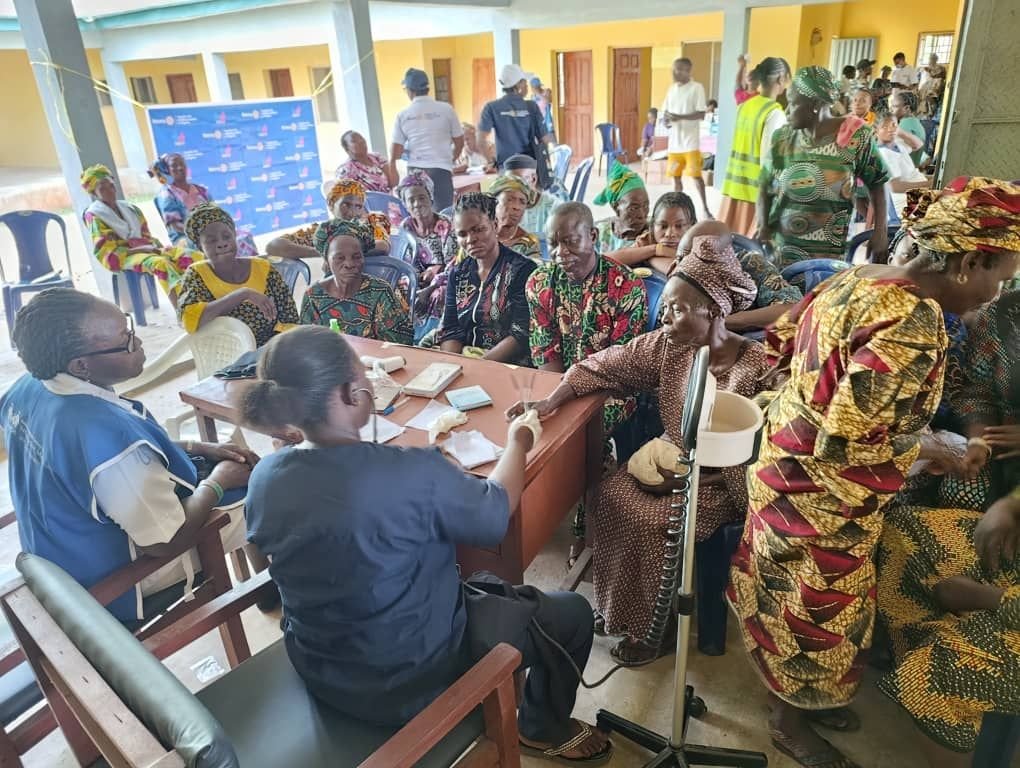


Residents of Ayegunle and Awo Ekiti received free medical care as Rotary’s Reproductive Maternal and Child Health group teamed up with the state government for a community outreach.
Health workers set up under a simple yellow building in the heart of the community.
Local women, many dressed in colourful traditional attire, queued patiently for checks.
Doctors and nurses in uniform offered family planning advice, tested for malaria and HIV, screened eyes, and provided basic treatment.
Children played nearby while their mothers listened to talks on healthy living.
Mrs Abigael Ojo, one beneficiary, smiled after her consultation.
“I never thought such help would come to our village,” she said.
“Now I know how to space my children and protect them from common illnesses.”
This event forms part of the bigger “Together for Healthy Families in Nigeria” project.
Rotary International backs the initiative with substantial funding and partners with the Federal Ministry of Health.
The programme runs in Ekiti, Nasarawa, Gombe and the Federal Capital Territory.
Its clear aim is to cut maternal and newborn deaths by improving access to quality care in places where hospitals feel far away.
Nigeria still faces tough challenges with maternal health.
Many women give birth without skilled help, and complications can turn tragic.
Yet signs of progress appear. Recent reports show fewer deaths in health facilities, thanks to better primary care and community efforts.
In Ekiti, the outreach did more than hand out medicines.
Workers trained local health extension officers and spoke with community leaders.
They encouraged women to attend antenatal visits and taught families simple ways to prevent illness.
Similar outreaches have already reached thousands across the four states.
Dr Asonibade, who helped coordinate the Ekiti programme, explained the vision.
“We want every family to enjoy better health,” she noted.
“When mothers and children stay strong, entire communities thrive.”
The project also trains staff in emergency care for mothers and babies.
In one recent case in nearby Aaye, health workers saved a woman and her twins during a difficult labour by quickly moving her to a better-equipped centre.
Stories like this show the real difference on the ground.
As the programme expands to more facilities, organisers hope the changes will last.
They combine free services today with education that builds healthier habits for tomorrow.
For rural families who once struggled alone, this support brings new hope.
Rotary members say the work goes beyond medicine.
It strengthens partnerships between government, volunteers and ordinary people.
In a country where preventable deaths still claim too many lives, small steps in places like Ayegunle add up to meaningful change.