

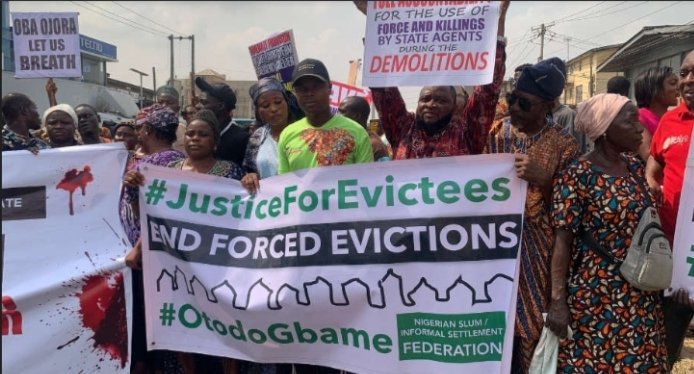

Makoko residents clashed with police on Wednesday, sparking tear gas chaos as they demanded an end to forced demolitions that have displaced thousands and claimed lives, including infants.
The protesters, comprising workers, traders, and civil society activists, marched from Ikeja under-bridge to the Lagos State House of Assembly gates, chanting for justice and carrying placards that read “Save our homes, lives and the Makoko community”.
The demonstration marks the latest flashpoint in a month-long drive that began in late December 2025 and intensified from January 5, 2026.
Lagos State authorities are targeting structures near high-tension power lines, citing safety reasons.
However, residents and rights groups insist clearances exceed the agreed 100-meter setback, reaching over 200 meters in places.
As the demolitions destroy homes, schools, clinics, churches, and livelihoods, authorities provide no adequate notice, compensation, or resettlement.
Community leaders report at least three deaths directly linked to operations, including two infants and an elderly woman who suffered severe respiratory distress after inhaling tear gas.
One grieving father recounted a tragedy, saying his wife slipped into the lagoon while fleeing tear gas with their baby, who later died in hospital.
Activists from HOMEF, CAPPA, and CEE-HOPE describe events as violent forced evictions, violating constitutional rights and international standards.
More than 10,000 people now sleep in canoes or crowd relatives’ homes after bulldozers razed over 3,000 structures.
Many hail from the historic fishing community dubbed the “Venice of Nigeria”, with fishers losing nets and boats, children dropping out of school, and families facing immediate hunger and exposure.
Environmentalists like Nnimmo Bassey condemn the actions, calling them “state-sanctioned oppression of the poor”.
A global coalition of 23 organizations demands an immediate halt, investigations into abuses, and proper resettlement.
Meanwhile, Lagos officials maintain demolitions protect residents from power line hazards, supporting urban renewal.
Tensions rise sharply now as residents vow to continue pressing for accountability, and humanitarian groups warn the crisis could worsen, making urgent intervention essential.