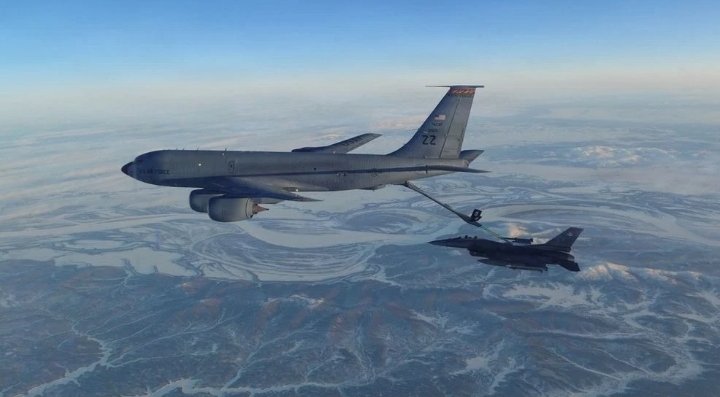


US Central Command has confirmed four deaths after a military refuelling aircraft crashed in western Iraq, with search teams still racing to find the two missing crew.
The KC-135 Stratotanker – essentially a flying fuel station that keeps fighter jets and bombers in the air for long missions – went down on Thursday afternoon during a routine operation.
It formed part of the wider US campaign against Iran, known as Operation Epic Fury.
The aircraft came down in what American officials describe as friendly airspace, and the military moved quickly to rule out any enemy action.
“Four of the six crew members on board have been confirmed deceased as rescue efforts continue,” Centcom said in a statement released early on Friday.
The circumstances remain under investigation, but the command stressed the loss “was not due to hostile fire or friendly fire”.
Identities of the dead will stay withheld for another day while next of kin are notified.
A second KC-135 tanker flew in the same formation.
It landed safely at its base, though reports suggest it may have taken damage in the incident.
That detail has only added to the mystery surrounding exactly what went wrong.
However, a very different story soon emerged from the ground.
The Islamic Resistance in Iraq – an umbrella of Iran-backed armed groups – claimed it shot the plane down with “the appropriate weapon” in defence of Iraqi sovereignty.
The group issued its statement within hours of the crash, posting images that appeared to show smoke rising from the desert.
Iranian state television picked up the narrative almost immediately, calling it a “successful strike” by local allies.
US officials pushed back hard.
They described the militia claim as false and pointed out that the area lies well inside controlled airspace used daily for coalition flights.
No surface-to-air missiles or drones were detected, they insisted, and the focus now sits squarely on possible mechanical failure, pilot error or a mid-air mishap between the two tankers.
The tragedy comes at a tense moment.
The US-Iran conflict has entered its second week, and American military deaths in the theatre now stand at eleven.
Oil prices have climbed above $100 a barrel, the Strait of Hormuz remains effectively closed, and fresh explosions were reported near Dubai after drone interceptions earlier the same day.
Rescue teams continue to scour the remote western Iraqi desert.
Recovery operations are complicated by the vast, empty terrain and the ongoing security threats from pro-Iran militias that operate in the region.
Families back home wait anxiously for news of the two still unaccounted for.
This is not the first aircraft lost since the fighting began, but the downing of a large refuelling tanker carries extra weight.
These planes rarely grab headlines, yet they keep entire air campaigns alive.
Without them, fighter jets cannot reach distant targets or loiter overhead for hours.
Their absence would force commanders to rethink how they sustain pressure on Iranian forces.
Meanwhile, the crash has already sparked sharp reactions online.
Some posts celebrate the losses and label the crew “terrorists”; others simply call for the war to end before more young lives are lost.
In Washington, the Pentagon has promised a full inquiry, but for now the focus remains on bringing the missing airmen home and supporting their grieving families.
As investigators piece together the final moments of the flight, one thing is already clear: this single incident has thrown fresh light on the hidden costs of keeping a modern air war running thousands of miles from home.