

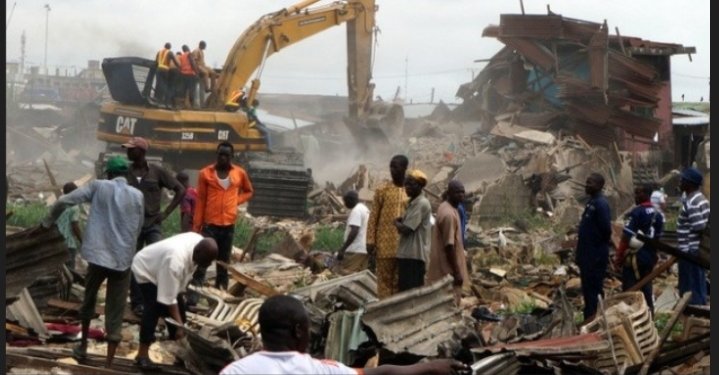

Human rights lawyer Femi Falana condemns Lagos State’s ongoing demolitions in Makoko and Iwaya as unlawful, urging immediate halt after court rulings.
Falana invoked a 2024 Supreme Court decision that assigns exclusive authority over inland waterways to the federal National Inland Waterways Authority (NIWA), stripping states of such powers.
In addition, Falana pointed to multiple court injunctions, including one from August 2025 by Justice F.N. Ogazi of the Federal High Court in Ikoyi, which explicitly barred further evictions without due process.
The demolitions, which intensified in late 2025 and continued into January 2026, have left thousands homeless and claimed at least 12 lives, according to a coalition of rights groups.
Residents report sudden raids that destroyed homes, schools, and clinics, forcing families to sleep amid rubble without compensation or relocation plans.
For instance, activists like Gbadebo Rhodes-Vivour highlighted how developers ignored a February 2025 court order reaffirming protections for Makoko, Sogunro, and Iwaya residents, yet proceeded with dredging activities.
Moreover, a Federal High Court ruling awarded ₦3.5 billion in damages against the Lagos government for prior unlawful demolitions in Makoko, declaring the police killing of a community leader unconstitutional.
Despite this, Falana accused the state of flouting the rule of law by demolishing over 100 properties just days after an October 2025 interim injunction he secured.
Rights organizations echoed his outrage, labeling the actions as systemic oppression that disproportionately affects the urban poor in fishing communities.
However, the Lagos State Government defended the operations as essential urban renewal and environmental safeguards, claiming years of engagement with residents and offers of alternative housing.
Officials dismissed allegations of no notice, insisting the moves address flooding risks exacerbated by unauthorized structures.
Nevertheless, critics like Falana argued that no governor possesses constitutional authority to demolish buildings without federal oversight on waterways.
As protests mount and videos circulate showing devastated families in canoes amid the ruins, the controversy spotlights deeper tensions between state development ambitions and federal jurisdiction.
Falana vowed that victims nationwide will pursue legal recourse, warning against executive overreach that leads to humanitarian crises.
With thousands displaced and calls for accountability growing, observers watch closely for potential intervention from higher courts or international bodies.