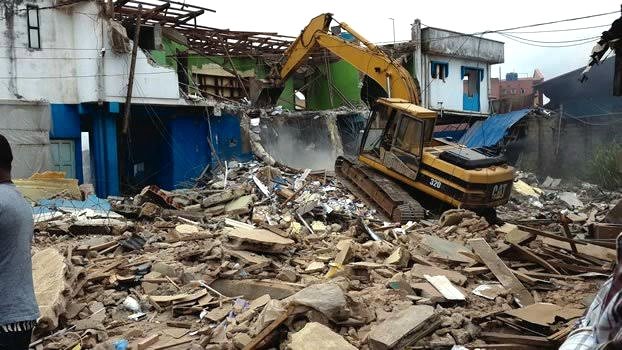

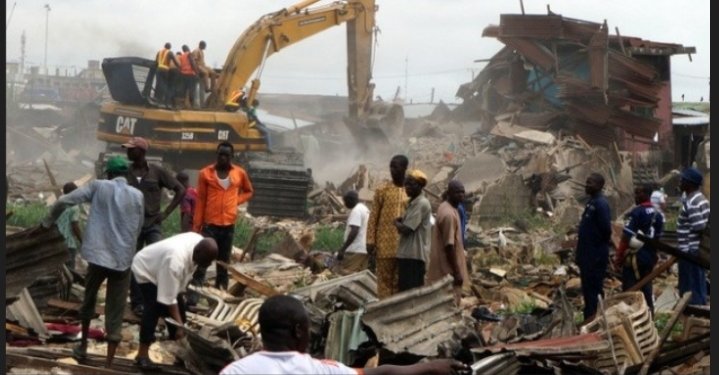

Bulldozers tear through graves in Oworonshoki and force families to exhume decomposed relatives during Lagos State demolitions.
Residents of the waterfront community in Kosofe Local Government Area now perform second burials for relatives they already mourned years earlier.
Demolitions first hit Oworonshoki in 2023, but they intensified without warning in September and December 2025.
Bulldozers flattened homes, shops and burial plots on family land.
Families fled at night as machines crushed concrete slabs over graves.
They later returned with shovels, goats and traditional healers to reclaim what remained of their dead.
Olusegun Thomas still reels from the day crews destroyed his brother’s resting place.
Thomas John Titilayo, a retired fisherman, died on November 30, 2024, after a stroke.
He had begged to stay buried on the land he bought.
“My brother mandated to be buried here, and not to be taken anywhere else,” Thomas told FIJ.
Crews exhumed the body about 10 months later.
The family moved the remains to Atan Cemetery.
They spilled goat blood into the empty grave, feasted on the meat overnight and prayed to prevent further misfortune.
Bose Idowu faced the same nightmare with her father.
Retired police officer Elijah Oyanonye died in November 2019 at age 85.
The family held a three-day celebration and tiled his grave after his spirit reportedly complained of being “naked.”
Demolition crews destroyed the site in December 2025.
Idowu and relatives dug up the fully decomposed bones and carried them to Majidun in Ikorodu.
“We can’t leave him here,” she said. “If we leave our dead behind, he would constantly appear to us and disturb us nonstop.”
They killed a goat, poured its blood at both sites and buried the head with the remains to block mass deaths.
Olamide Ebifemi lost both parents on the same plot.
His mother Aishat, a Lagos Waste Management sweeper, died in a truck accident on May 7, 2025.
His father Afolabi, a fisherman, passed suddenly in May 2021.
During the demolitions Aishat appeared in Ebifemi’s dreams.
“She just came to tell me that we should not leave her body behind,” he recalled.
The family exhumed both corpses—one fresh, one skeletal—and relocated them to Ikorodu.
They spent between ₦100,000 and ₦200,000 per grave on rituals, including sex-specific goats, kolanuts and schnapps.
Human rights defender Towolawi Jamiu called the actions illegal land grabbing.
“It’s illegal in the first place to ask them to evacuate their ancestral land, let alone exhume the dead of their loved ones without any court order,” he told FIJ.
Courts issued injunctions, yet demolition teams ignored them and proceeded under cover of darkness with armed police.
Lagos State officials defend the operations as necessary to fight flooding, environmental damage and crime.
They once labeled Oworonshoki a robbers’ den that targeted highway commuters.
The government has offered no direct response to the grave exhumations revealed this week.
Meanwhile, environmentalist Ugonna Nkemjika warns of wider danger.
Opening old graves releases trapped gases, dust and embalming chemicals into the soil and nearby Lagos Lagoon.
These pollutants threaten aquatic life and residents’ health in an already polluted megacity.
United Nations experts joined the outcry on Wednesday.
They condemned the evictions across Oworonshoki and other lagoon communities as violations of international standards.
The experts noted that demolitions since July 2023 displaced tens of thousands, destroyed schools and clinics, and ignored proper notice or compensation.
On February 3 the state announced a suspension and promised talks with UN agencies, yet families still sleep amid rubble and fear fresh bulldozers.
Moreover, the cultural wound runs deep in Yoruba tradition.
Residents believe abandoning graves invites restless spirits and community shame.
Exhumers call the deceased by name during digging to reassure the soul.
One practitioner explained the blood ritual prevents “more people could die.”
Subsequently, thousands now face the impossible choice between homelessness and dishonoring their ancestors.
The FIJ investigation shows how urban renewal in Africa’s largest city extracts a price from both the living and the dead.
As one family member put it, “Dead people are not entirely dead.” In Oworonshoki today, they suffer twice.