


A powerful 7.5-magnitude earthquake struck beneath the Pacific Ocean off the coast of Aomori Prefecture in northern Japan on Monday evening, injuring at least 30 people, triggering small tsunami waves, and prompting the evacuation of more than 90,000 residents in freezing winter conditions.
The quake, which hit at 6:29 p.m. local time (09:29 GMT), was centred 60 kilometres east-southeast of the town of Mutsu at a depth of 45 kilometres, according to the Japan Meteorological Agency (JMA).
Intense shaking lasting nearly two minutes was felt across Tohoku and southern Hokkaido, reaching upper 6 on Japan’s 7-level seismic intensity scale in parts of Aomori and Iwate prefectures.
Within minutes, tsunami advisories were issued for coastal areas of Aomori, Iwate, and Hokkaido. Waves of up to 50 centimetres were recorded at the port of Hachinohe, while smaller surges reached several other locations.
All advisories were lifted by 11:00 p.m. after no significant damage from the tsunami was reported.
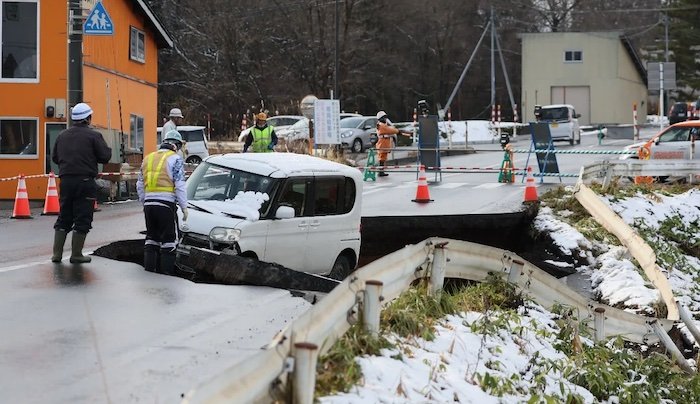
Dramatic images from the town of Hakodate and surrounding areas showed deep cracks splitting roads, with at least one vehicle left precariously wedged in a fissure – a stark reminder of the ground’s violent movement.
Local hospitals treated 30 people for injuries ranging from fractures to cuts caused by falling objects, though authorities said none were life-threatening.
Power outages affected more than 12,000 households at the peak, and several sections of the Tohoku Shinkansen high-speed rail line were temporarily suspended for safety inspections.
By Tuesday morning, most services had resumed.
The earthquake marks the strongest tremor since Japan issued its first-ever “Nankai Trough Megaquake Advisory” in August 2024, which warned of a heightened risk of a magnitude-8 to 9 event along the country’s southern coast.
While Monday’s quake was unrelated to the Nankai Trough, it has reignited national anxiety about living on the Pacific Ring of Fire.
“This shook harder than anything I’ve felt since 2011,” said 68-year-old fisherman Hiroshi Tanaka, who fled to higher ground in Hachinohe with his family.
“We know what can happen. We didn’t wait for the sirens.”The 2011 magnitude-9.0 Great East Japan Earthquake and tsunami killed nearly 20,000 people and triggered the Fukushima nuclear disaster.
That collective memory drove swift and orderly evacuations on Monday night despite sub-zero temperatures and snow on the ground.
Prime Minister Shigeru Ishiba convened an emergency response meeting late Monday and urged residents to remain vigilant for aftershocks.
“Japan is a nation that lives with earthquakes,” he said in a televised address. “Our thoughts are with those injured, and we will continue to place the highest priority on saving lives.”
As of Tuesday afternoon, more than 300 aftershocks had been recorded, the strongest measuring magnitude 6.1. Seismologists warn that significant aftershocks could continue for days or weeks.
For the people of Tohoku, still rebuilding from 2011, the latest quake is both a painful echo of the past and a fresh test of resilience.
Yet the rapid evacuations, limited casualties, and swift return to normalcy also underscore how far Japan’s disaster preparedness has come in the intervening years.